


Managing employees effectively is at the heart of every successful organization. As businesses grow, handling employee data, performance, attendance, and communication becomes increasingly complex. Without a structured system, these tasks can quickly become time-consuming and error-prone.
Modern organizations are now shifting towards digital solutions to streamline employee-related operations. An employee management system helps businesses centralize information, improve productivity, and enhance workforce efficiency. This blog provides a complete overview of employee management, its core functions, benefits, and the importance of adopting the right software solution.
Employee management refers to the process of overseeing and organizing all aspects of an employee’s journey within an organization. It includes managing employee information, performance, attendance, communication, and overall engagement.
The goal of employee management is to ensure that employees are productive, satisfied, and aligned with business objectives. It also helps HR teams maintain accurate records and create a structured work environment.
In today’s digital era, employee management is no longer limited to manual processes. Businesses rely on advanced systems to automate routine tasks and improve decision-making.
Employee management involves several essential functions that support daily HR operations and long-term business goals. These functions help organizations maintain structure, improve efficiency, and ensure smooth workforce management.
Key functions include maintaining employee records, tracking attendance, monitoring performance, managing communication, and ensuring compliance with company policies. These processes enable HR teams to focus on strategic initiatives rather than administrative tasks.
A well-structured employee management approach also improves transparency within the organization, allowing employees to clearly understand their roles, responsibilities, and performance expectations.



An employee management system provides a centralized platform to store all employee-related data, including personal details, job roles, salary information, and documents. This eliminates the need for multiple spreadsheets and ensures data accuracy and easy access.
Modern systems include performance tracking tools that help managers evaluate employee productivity and progress. Real-time reports and analytics support better decision-making and help identify areas for improvement.
In addition to these, employee management systems often include attendance tracking, leave management, document management, and employee self-service portals. These features enhance operational efficiency and reduce manual workload.
An employee management system offers significant advantages for HR teams by simplifying daily operations and improving overall efficiency.
Automation reduces the time spent on repetitive tasks such as data entry and record maintenance. This allows HR professionals to focus on strategic activities like employee engagement, talent development, and appraisal management, ensuring continuous performance improvement.
The system also improves accuracy by minimizing manual errors, ensuring reliable employee data and reporting. With easy access to information, HR teams can respond quickly to employee queries and organizational needs.
Additionally, better data management supports appraisal management processes by providing real-time performance insights, leading to improved decision-making and helping businesses plan workforce strategies more effectively.
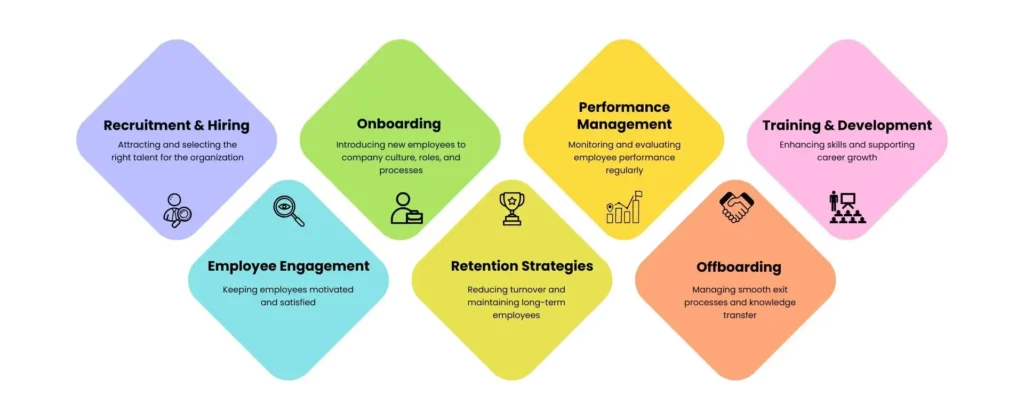
Employee lifecycle management is the structured approach to managing every stage of an employee’s journey within an organization—from recruitment and onboarding to performance management, development, engagement, retention, and offboarding. By following a well-defined lifecycle, businesses can ensure consistency, enhance employee experience, and improve overall productivity.
Without a proper system, employee data is often scattered across multiple files and platforms. This leads to inconsistencies, duplication, and errors, making it difficult to maintain accurate records.
Manual handling of employee information, attendance, and performance tracking consumes significant time and effort. It slows down HR operations and reduces overall productivity.
Other challenges include lack of transparency, difficulty in tracking employee performance, and increased risk of compliance issues. These problems can impact both employee satisfaction and business growth.
Employee management plays a vital role in ensuring organizational success. As businesses expand, managing employees manually becomes inefficient and unsustainable.
Adopting an employee management system helps organizations streamline operations, improve accuracy, and enhance employee experience. It empowers HR teams to focus on strategic goals while ensuring smooth day-to-day management.

Adaptive delivers innovative ERP solutions that accelerate business growth through collaboration and transparency.
C53/2, Sky Towers, 3rd Cross Rd, Thillai Nagar, Tiruchirappalli,620018
© 2026 Adaptive System Pvt Ltd. All Rights Reserved.