


Every growing business reaches a point where managing people and tasks manually becomes a challenge. Emails, spreadsheets, and verbal instructions may work for small teams, but as operations scale, these methods create confusion, delays, and inefficiencies.
Modern organizations need a smarter approach to ensure that work is planned, assigned, and completed without bottlenecks. This is where task and workforce management systems come into play. They bring structure, visibility, and control into daily operations, helping teams stay aligned and productive.
Workforce management (WFM) is the strategic approach businesses use to ensure their employees are effectively utilized to meet organizational goals. It involves planning, scheduling, and monitoring the workforce so that the right people with the right skills are available at the right time. By streamlining processes such as time tracking, attendance, and task allocation, workforce management helps organizations improve productivity while maintaining operational efficiency.
In today’s digital era, workforce management has evolved beyond basic administration to include advanced tools like analytics, automation, and real-time reporting. These technologies enable businesses to make informed decisions, reduce labor costs, and enhance employee engagement. Ultimately, effective workforce management not only improves internal operations but also contributes to better customer satisfaction and long-term business success.
The success of any organization depends on how effectively tasks are distributed among employees. A well-defined task allocation process ensures that work is completed efficiently without overloading individuals.
It begins with identifying priorities and breaking down projects into smaller, actionable tasks. These tasks are then assigned based on employee skills, experience, and availability. A good system ensures that workloads are balanced, preventing burnout and improving efficiency.
Once tasks are assigned, employees receive clear instructions and deadlines. Managers can monitor progress and make adjustments when necessary. This structured approach not only improves accountability but also ensures that projects are completed on time.


A robust workforce management system streamlines team and task management, helping businesses operate more efficiently. It enables real-time task management, ensuring clear responsibilities and better accountability. Automated scheduling optimizes shift planning and reduces manual workload. Performance tracking tools provide valuable insights into employee productivity and areas for improvement. With mobile access and advanced reporting, businesses can stay connected, make data-driven decisions, and improve overall coordination.
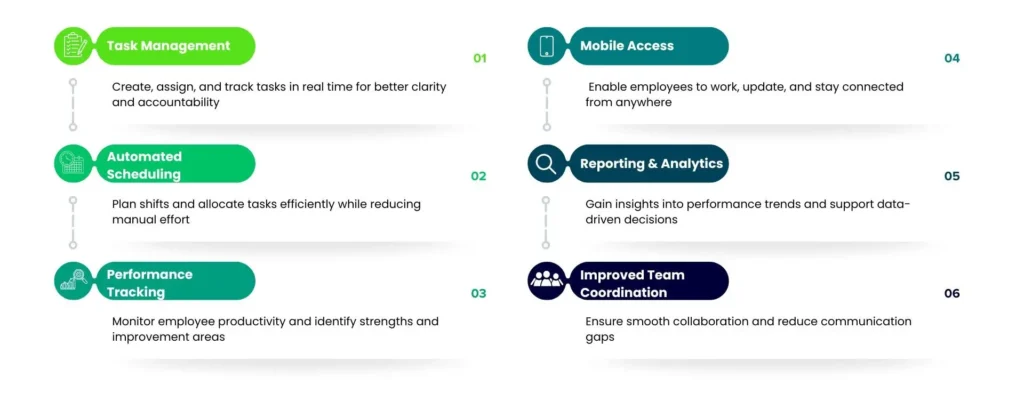
A workforce management system plays a vital role in improving overall organizational productivity by streamlining daily operations and optimizing employee performance. It provides clear task allocation, ensuring that employees understand their responsibilities and can focus on completing their work efficiently.
By enabling smart scheduling and prioritization, it helps teams manage their time better and meet deadlines without unnecessary pressure. Real-time monitoring allows managers to track progress, identify bottlenecks, and ensure tasks are completed on time.
Additionally, it promotes better utilization of resources by distributing workloads evenly across the team. This not only prevents burnout but also maximizes employee potential. When integrated with compliance management, it further ensures that all processes align with regulatory standards and organizational policies. Ultimately, workforce management systems foster collaboration, improve efficiency, and drive higher business performance.
In today’s fast-paced work environment, real-time tracking is essential for effective workforce management. It allows managers to monitor ongoing tasks and make quick decisions when needed.
With real-time tracking, managers can see the status of tasks—whether they are pending, in progress, or completed. This visibility helps in identifying delays and resolving issues immediately.
Employees can update their progress instantly, ensuring that everyone stays informed. For businesses with field teams, location-based tracking can also be integrated to monitor movement and improve coordination.
Real-time insights not only enhance efficiency but also improve communication and transparency across teams.
Despite its importance, workforce management comes with several challenges, especially when handled without proper tools. One of the major issues is lack of coordination, which can result in missed deadlines, confusion, and reduced overall productivity. Uneven workload distribution is another common problem, where some employees are overloaded with tasks while others remain underutilized, leading to inefficiency and dissatisfaction within the team.
In addition, communication gaps often create misunderstandings, particularly in remote or distributed work environments where clear interaction is essential. Businesses also struggle with accurate performance tracking, as manual methods fail to provide real-time insights and reliable data. These challenges highlight the need for a structured and automated workforce management system to improve efficiency, transparency, and overall organizational performance.
Task and workforce management is a critical function that directly impacts business performance. As organizations grow, managing teams and tasks manually becomes inefficient and error-prone.
A modern workforce management system provides the tools needed to streamline operations, improve productivity, and ensure better coordination. From task allocation to real-time tracking, it brings clarity and control to every aspect of team management.
For businesses looking to scale efficiently, adopting a smart workforce management solution is not just beneficial—it is essential for long-term success.

Adaptive delivers innovative ERP solutions that accelerate business growth through collaboration and transparency.
C53/2, Sky Towers, 3rd Cross Rd, Thillai Nagar, Tiruchirappalli,620018
© 2026 Adaptive System Pvt Ltd. All Rights Reserved.