Performance management is a critical process that helps organizations monitor, evaluate, and improve employee performance. In today’s competitive business environment, companies need structured systems to ensure that employees are aligned with organizational goals and continuously improving their skills.
Traditional performance reviews are no longer enough. Businesses are now adopting performance management software to track progress in real time, provide continuous feedback, and make data-driven decisions. A modern performance system not only enhances employee productivity but also supports long-term business growth.
Performance management is the process of setting goals, monitoring employee performance, providing feedback, and evaluating results to ensure that individuals contribute effectively to organizational success.
It involves continuous communication between employees and managers, focusing on development rather than just evaluation. With the help of performance management systems, businesses can automate goal tracking, feedback collection, and performance reviews, making the process more efficient and transparent.
Key performance metrics help organizations measure employee and business success effectively.
Key Performance Indicators (KPI) are measurable values that indicate how well an employee or organization is achieving specific objectives. Examples include sales targets, customer satisfaction scores, and project completion rates.
Objectives and Key Results (OKR) focus on setting ambitious goals and tracking outcomes. Objectives define what needs to be achieved, while key results measure progress toward those goals. OKRs help teams stay aligned and motivated by providing clear direction and measurable results.
Modern performance management systems come with a wide range of features designed to simplify and enhance performance tracking. These systems enable effective goal setting and tracking, allowing employees and managers to define clear objectives and monitor progress in real time. They also include continuous feedback mechanisms, which encourage regular communication between employees and managers, supporting ongoing improvement and development. Additionally, performance reviews and appraisals are automated, ensuring consistency, accuracy, and fairness in evaluations. Advanced analytics and reporting tools provide valuable insights into employee performance, helping organizations make data-driven decisions. Furthermore, seamless integration with other HR systems such as payroll and attendance ensures efficient and centralized workforce management.







Implementing performance management software offers several advantages for businesses by improving overall efficiency and workforce performance. It helps boost employee productivity by clearly defining goals and expectations, enabling employees to stay focused and perform better. With access to real-time data and analytics, managers can make informed and fair decisions, reducing bias and improving outcomes. Continuous feedback and recognition enhance employee engagement, increasing motivation and job satisfaction. Additionally, the system ensures that individual performance aligns with organizational goals, driving business success. When integrated with employee management and attendance management systems, organizations can achieve better workforce visibility and streamlined operations. By supporting employee growth and development, it also reduces turnover, helping organizations retain valuable talent and maintain stability.
Performance reviews have evolved significantly over time.
Traditional reviews are usually conducted annually or semi-annually. They focus on past performance and often lack real-time feedback, making it difficult for employees to improve quickly.
Continuous performance management, on the other hand, involves regular check-ins, ongoing feedback, and real-time goal tracking. This approach allows employees to make improvements continuously and stay aligned with business goals.
Modern organizations prefer continuous performance management because it is more flexible, transparent, and effective in driving employee development.
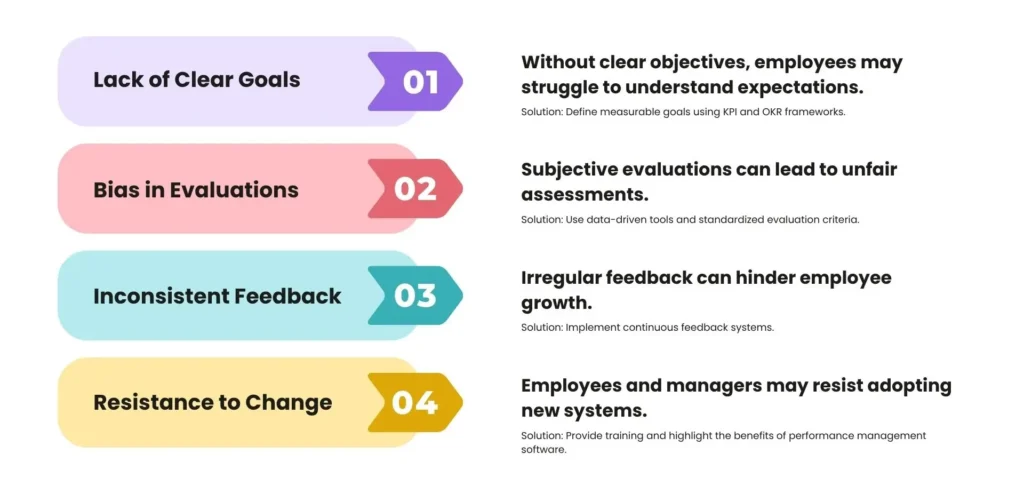
Despite its benefits, performance management comes with certain challenges.
Performance management is essential for improving employee productivity and achieving business success. By adopting modern performance management software, organizations can streamline processes, enhance transparency, and make better decisions.
With features like goal tracking, continuous feedback, and analytics, businesses can create a culture of growth and accountability. Investing in a strong performance management system not only benefits employees but also drives long-term organizational success.
Adaptive leads in ERP solutions, transforming business growth through collaboration, transparency, and innovative strategies that keep clients ahead of the competition
© 2025 Adaptive System Pvt Ltd. All Rights Reserved.